Welcome to CPA at Law, helping individuals and small businesses plan for the future and keep what they have.

This is the personal blog of Sterling Olander, a Certified Public Accountant and Utah-licensed attorney. For over thirteen years, I have assisted clients with estate planning and administration, tax mitigation, tax controversies, small business planning, asset protection, and nonprofit law.

I write about any legal, tax, or technological information that I find interesting or useful in serving my clients. All ideas expressed herein are my own and don't constitute legal or tax advice.

Legal Doc Template in Microsoft Word

As anyone who drafts legal documents knows, it can be difficult to manage all of the section numbers, references to section numbers, table of contents, headings, and formatting. This post will describe tips for managing some of these variables in a commonly-used legal document format. The objective is a manageable legal document that looks like this:
ARTICLE I. INTRODUCTION

          Section 1.01 Detailed Introduction. This section number corresponds with the Article number (i.e., Section 1.01 is the first section of Article I, Section 2.3 appears in Article II, etc). Additionally, this section begins with a summary phrase describing what the section is about, and that phrase is formatted differently than the rest of the paragraph (in this case, it is underlined).

                  (a) If Article I becomes Article II due to another article being added in front, it is critical that all of the sections numbers automatically update, for example, sections 1.01 through 1.06 become 2.01 through 2.06, and so on throughout the document.

                  (b) It is also important that the "Detailed Instructions" introductory phrase be a "Heading" in Microsoft Word, but that the language that follows be excluded. The reason for this is so that a detailed Table of Contents can be automatically generated.

                  (c) If a section is referenced within a sentence of the document, such as "see Section 1.01," it is critical that this reference update automatically when Section 1.01 changes to Section 2.01, and so on.

Here are instructions on how to accomplish these time-saving objectives using easy-to-manage formatting tools:

The first key to consistent formatting is to avoid all direct formatting in Word documents and instead use styles. There are dozens of websites that discuss how to do this (here is a link to one example), and so this won't be dealt with in detail here. However, as a starting point, it is helpful when Word identifies text that is formatted directly; to enable this, go to Word Options, Advanced, and make sure "Keep track of formatting" and "Mark formatting inconsistencies" are both selected.

The next key is to utilize Headings that are integrated with Multilevel List numbering. To being, open a new Word document, type the word "Introduction," select all, and, from the Paragraph section of the Home tab, choose to format everything as the Multilevel List option highlighted in the screenshot to the right:

This causes "Article I." to be automatically added before the word "Introduction" in the document you just created. By right-clicking on "Article I," selecting "Numbering," and "Change List Level," you can change the outline level of the text. See if you can reproduce the sample document above by copying and pasting the text and formatting as Headings/Styles and adjusting the list levels of each Article/Section/Paragraph. All formatting should be done by right-clicking on the applicable style in the "Style" section of the Home tab, selecting Modify, and formatting in this way; alternatively, you can temporarily apply direct formatting to the text, right-click the applicable style, and select "Update Heading to match selection."

The next task is to cause the text that follows "Section 1.01. Detailed Introduction" above to be formatted as a non-heading. To do this, hit "Enter" after "Detailed Introduction" so that the text that follows is in a separate paragraph, then click anywhere in the "Detailed Introduction" paragraph and press Alt+Ctrl+Enter to insert a style separator and bring the subsequent text up. For more details, see this link.
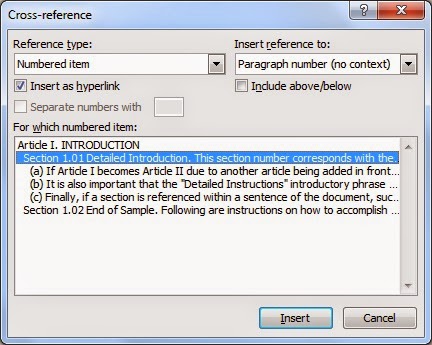
Next, we want to provide for automatic updates to references to a Section. To accomplish this, don't type the reference to Section 1.01 directly; instead, select the Insert tab and click Cross Reference. In the box that pops up, select "Numbered item" for "Reference type", select "Paragraph number (no context)" for "Insert reference to", and pick the applicable numbered item from the list in the box below, as illustrated here.

Finally, all that is left to do is generate a Table of Contents from the References tab. After editing the contract terms and immediately prior to printing, update the Table of Contents and section references throughout the document by selecting all and pressing F9.

Tax Protester Arguments Work, Until They Don't

Certain individuals and groups insist that portions of the Internal Revenue Code do not apply to them. The reasoning in support of this position is generally based upon words and phrases in statutes and cases taken out of context. Many of these arguments have been deemed "frivolous" by the IRS, the making of which subjects the "tax protester" to additional penalties.

Because the U.S. tax system depends, in large part, on voluntary compliance, tax protesters can point to various circumstances as "proof" that the techniques "work," at least temporarily. The IRS may accept tax returns with obviously understated income or overstated expenses and may pay out refunds as well. This "works," as Peter J. Reilly, writing for Forbes, pointed out, "if you are just about maximizing your current lifestyle rather than accumulating net worth and entirely amoral when it comes to meeting tax obligations."

Collection due process affords taxpayers a chance to appeal to the Tax Court, a process I outlined in a previous post. All tax protester arguments fail at Tax Court, the result being a judgment against the taxpayer for taxes due and probably penalties. While most Tax Court judges don't bother writing an opinion in tax protester cases, Judge Ronald L. Buch, a new Tax Court judge, took the opportunity to write a very detailed opinion in a recent one. The discussion section of the opinion beings with this, which should cause would-be tax protesters to reconsider their course of action:
This case has occupied an inordinate amount of the Court’s time. The Court could have disposed of the entire matter summarily by reference to Crain v. Commissioner or any number of 6 other cases that stand for the proposition that we need not address frivolous arguments (citing Crain v. Commissioner, 737 F.2d 1417, 1417 (5th Cir. 1984) ("We perceive no need to refute these arguments with somber reasoning and copious citation of precedent; to do so might suggest that these arguments have some colorable merit.")
The case, Waltner v. Commissioner, TC Memo 2014-35, is a good read for anyone who thinks they may have found a book or website promoting a loophole in the Internal Revenue Code. Judge Buch had a clear intent to "inform the public of the court’s analysis" of frivolous positions of tax protesters. Hopefully, some will listen.

The Bypass Trust: To "B" or Not to "B"?

For many years, estate planners recommended planning that involved an "A/B trust" structure whereby assets of the first spouse to die equaling the estate tax exemption in value would end up in a trust to preserve that spouse's estate tax exemption. This prevented the surviving spouse from being "left with the couple's assets, but only their own individual exemption." Depending on a number of factors, this strategy could potentially save millions of dollars in estate taxes.

The costs of this trust, which is known by many names including a "B Trust," "Credit Shelter Trust," "Family Trust," or "Bypass Trust," are not insignificant. The surviving spouse's access to the assets of the B Trust are necessarily restricted, tax returns must be filed each year the trust is in existence and has income, legal responsibilities are imposed on the surviving spouse or a non-spouse trustee for trust management, and there is no step-up in basis for the B Trust assets at the surviving spouse's death.

Until recently, these costs could easily be justified by the potential estate tax savings. After the American Taxpayer Relief Act, however, the law allows the deceased spouse's unused exclusion amount to be transferred to the surviving spouse without the need for a B Trust. The unused exclusion must be calculated, and an election to transfer the unused exclusion made, on a timely filed estate tax return of the first spouse to pass away.

Rev. Proc. 2014-18, effective January 27, 2014, allows for an extension of time to make this "portability" election for decedents who passed away in 2011, 2012, or 2013 and who were survived by a spouse. Such elections, made in conjunction with the filing of an estate tax return, must be filed by December 31, 2014.

There are still benefits of a B Trust, namely, asset protection for the assets held by the trust, asset appreciation value that is excluded from estate tax, and greater certainty that the bequests contemplated by the first spouse to die will be carried out. However, the estate tax benefits to the B Trust have been reduced.

While it a good idea for everyone to review their estate plan every few years anyway, it is particularly appropriate for those with A/B trust provisions included in a revocable trust package to review whether that is still appropriate. For surviving spouses stuck managing a B trust that is no longer justified, it is appropriate to have the trust reviewed to see if it can be modified to better achieve that spouse's objectives.

Activities of Charitable Organizations

Individuals wanting to form their own charitable organization are not alone; the number of public charities has increased substantially in the past few years. I.R.C. section 501 describes certain organizations that are exempt from tax. Section 501(c)(3) and Treas. Reg. 1.501(c)(3)-1(d)(2) generally describe the following exempt purposes for which a charity can be organized:

Religious Organizations. Includes organizations operated exclusively for religious purpose and organizations that advance religion. Some, but not all religious organizations qualify as a "church," which are treated somewhat preferentially compared to other religious organizations.

Organizations Providing Relief for the Poor Underprivileged. These are the "classic" type of charitable organizations; they are permitted to provide a wide range of assistance for low-income persons, including transportation, housing assistance, counseling, legal aid, and day care services.

Social Welfare Organizations. Includes organizations that build or maintain public buildings, monuments, or works; lessen the burdens of government; lessen neighborhood tensions; eliminate prejudice and discrimination; defend human and civil rights secured by law; or combat community deterioration and juvenile delinquency.

Health Organizations. Includes hospitals and health-care providers that promote the health of the community and which provide below-cost medical services to lower income individuals.

Scientific Organizations. Includes organizations that perform research that is beneficial to the public and that is normally made available to the public as well.

Public Safety Testing Organizations. Includes organizations that test consumer products, construction standards, and equipment for safety.

Educational and Literary Organizations. Includes organizations that train individuals so as to develop their capabilities or the instruction of the public on subjects beneficial to the community. Many other types of charitable organizations also have educational purposes.

Amateur Sports Competition Organizations. Includes organizations that operate exclusively to foster national or international amateur sports competition, as long as they do not provide athletic facilities or equipment.

Organizations for the Prevention of Cruelty to Children or Animals. Includes organizations protecting children from unfavorable work conditions and animal welfare organizations.

Source: Webster, 451 T.M., Tax-Exempt Organizations: Operational Requirements.

Medicaid Eligibility for a Married Individual

Medicare is a federal entitlement program available to seniors regardless of need and works like health insurance. In contrast, Medicaid is a health benefit program for low-income individuals. "Medicaid planning," normally refers to qualifying for long-term care benefits under Medicaid. Long-term care costs thousands of dollars per month and coverage is not available under Medicare and most health insurance plans. This post will focus on Medicaid qualification in Utah for a married individual.

In order to be eligible for Medicaid, an applicant cannot have more than $2,000 in assets. However, some assets do not count toward this limit; moreover, some "countable" assets can be converted to "non-countable" assets. First, an in-state residence is not a countable asset unless the applicant does not intend to return home and no spouse or dependent lives there. The cash value of a life insurance policy up to $1,500 is exempt, as is up to $1,500 that is specifically designated as a funeral fund. Irrevocable prepaid funeral plans, cemetery plots, and household items are also exempt. It is generally permissible to purchase these items or pay down a mortgage or other debts in order to reduce countable assets and qualify for Medicaid. However, the applicant cannot have more than $525,000 of equity in a residence.

In addition, spouses of applicants who live at home can keep some assets. A Medicaid worker will value all of a couple's countable assets and divide by two. The spouse can keep half, with a minimum of around $23,000 and a maximum of around $114,000 (which changes each year). The applicant is still limited to $2,000 of assets, meaning that if the couple has more than $25,000 in total non-exempt assets, the excess attributable to the applicant spouse must be spent down before they will qualify for Medicaid. In addition, the non-applicant spouse can keep some of the income of the applicant spouse once the applicant spouse is in a nursing home.

Certain transfers of assets do not affect Medicaid eligibility, such as transfers to a spouse or certain transfers to disabled individuals. However, nearly all other transfers made within five years prior to applying for Medicaid are of no benefit for eligibility purposes because applicants must report all such transfers made for less than fair market value. Making transfers of non-exempt assets within this timeframe will be detrimental due to the Medicaid sanction rules.

It is critical that an individual consults with a Medicaid expert before applying in order to avoid making transfers that will result in sanctions or spending assets they would have been allowed to keep. Proper planning will allow a spouse remaining at home to be more financially secure.

The state will seek to recover funds paid by Medicaid from the estate of a recipient after the death of the recipient and the surviving spouse, so long as there is no minor or disabled child. Even though an asset may have been exempt for Medicaid qualification purposes, it will not be exempt from estate recovery. For more information, including the sources for this post, see the pamphlets provided by the Utah Department of Health entitled “Estate Recovery Information Bulletin”, DWS 05-994, "Nursing Home Information, May we be of service to you?” DWS 05- 969, and “Assessment of Assets” DWS 05-992.

Captive Insurance Companies

Insurance does two things: First, it shifts a risk from an insured to the insurance company. Second, it distributes the risk taken on by the insurance company among a pool of like risks with a predictable number of risks that will materialize. In other words, from the insured’s perspective, insurance shifts risks; and from the insurer’s perspective, insurance distributes risk.

This is the view of insurance from a tax perspective and helps explain why historically, the IRS challenged "captive" insurance companies, or insurance companies owned by the insured. The IRS argued that true risk shifting and distribution could never occur within the same "economic family" and that as such, deductible premiums by the insured were really non-deductible contributions to a reserve fund.

Beginning with the case of Humana v. Commissioner, 88 T.C. 197 (1987), which was discussed at length in the recent case of Rent-A-Center, Inc. v. Commissioner, 142 T.C. No. 1 (2014), the IRS started consistently losing this argument. Eventually, in Rev. Rul. 77-316, the IRS announced that it would no longer rely on its economic family argument. Currently, there are a few safe harbors that taxpayers can rely upon to obtain the expected tax treatment of their captive insurance companies and payments made thereto. However, as Rent-A-Center makes clear, the IRS can still litigate based on facts and circumstances of individual scenarios.

Rev. Rul. 2002–89 and Rev. Rul. 2002-90 stand for the following two safe harbors: If a captive insurance company either (1) receives at least 50% of its income from a non-parent or (2) provides insurance for at least twelve subsidiaries, with no subsidiary accounting for less than 5% or more than 15% of the total risk underwritten, the IRS will normally concede that adequate risk shifting and distribution has occurred and not challenge the captive arrangement. 11 Mertens Law of Fed. Income Tax'n § 44:24.

Firms who market and help clients establish captive insurance companies can help clients pool with third parties in order to meet these requirements. The viability of this strategy assumes that the captive is operated as a bona fide insurance company in every respect.

While captive insurance companies provide clear asset protection benefits, the tax benefits are substantial as well. If the captive qualifies and elects to be taxed as a "small company" under section 831(b) of the Internal Revenue Code, it will be taxed only on taxable investment income, not underwriting income. A captive insurance company can receive up to $1.2 million in annual premiums and still qualify under section 831(b). Effectively, this means that by establishing a captive insurance company, a taxpayer can reduce taxable income by deducting premiums of $1.2 million, while recognizing no taxable income to the captive. Assuming a good claims history, the premiums accumulate tax-deferred and are available to be withdrawn later as dividends or long term capital gains.

The IRS Audit and Appeals Process

After taxpayers file their tax returns, the IRS computer system analyzes the returns to verify that income, deduction, gain, and loss amounts reported to the IRS by third parties are properly reported on the taxpayers' returns. The system also gives each return a numeric score based on certain factors that the IRS has identified as indicative of error. Returns that have a high probability of error are screened by IRS personnel and in this manner, selected for audit. The first step in an audit is a letter from the IRS to the taxpayer providing notification that the return has been selected.

Examinations can be conducted through the mail or face-to-face. A taxpayer can represent themselves, but it is wise to have a good CPA or tax attorney assist. Hiring a reputable professional to assist with tax return filing and significant transactions in the first place can often prevent the kinds of problems that trigger IRS scrutiny of a tax return in the first place.

At the end of the audit, the IRS will provide the taxpayer a written explanation of any proposed changes to the tax return. If the audit results in a lower assessed tax (which is possible), the taxpayer will get a refund. If not, and the IRS takes the position that additional tax is owed, the taxpayer has a choice: Pay the additional tax, or contest the proposed changes.

If the audit meeting takes place at an IRS office, the taxpayer can immediately request a meeting with the examiner's supervisor. If the meeting takes place elsewhere or no agreement with the supervisor can be reached, the examiner will forward the case for processing. The IRS will prepare an examination report detailing the proposed adjustments as well as a "30 day letter."

The 30 day letter will inform the taxpayer of their right to an appeal from within the IRS to an independently-operated IRS Appeals office. A written request must be filed with the IRS office indicated in the letter in order to have the matter brought before the IRS appeals officer. Many matters can be settled with an IRS appeals officer, although the taxpayer can take the matter to court without IRS appeals.

If the taxpayer does not respond to the 30-day letter or an agreement cannot be reached, the IRS will send a Notice of Deficiency, or 90 day letter. The Notice of Deficiency gives the taxpayer 90 days to file a petition with the U.S. Tax Court. If no petition is filed, the IRS assesses the proposed tax and bills the taxpayer for the deficiency. Alternatively, the taxpayer can pay the disputed tax in full and file a claim for refund with the IRS. If the refund is denied, the taxpayer can file suit for refund in a Federal District Court or the Court of Federal Claims.

Throughout this process, there are a number of resources and options available, such as Taxpayer Advocate Service, Offers in Compromise, installment agreements, Alternative Dispute Resolution, etc. After the taxpayer's protest options have been exhausted, and if they are unable to pay, the collections process will commence. That will be the topic of a future post.